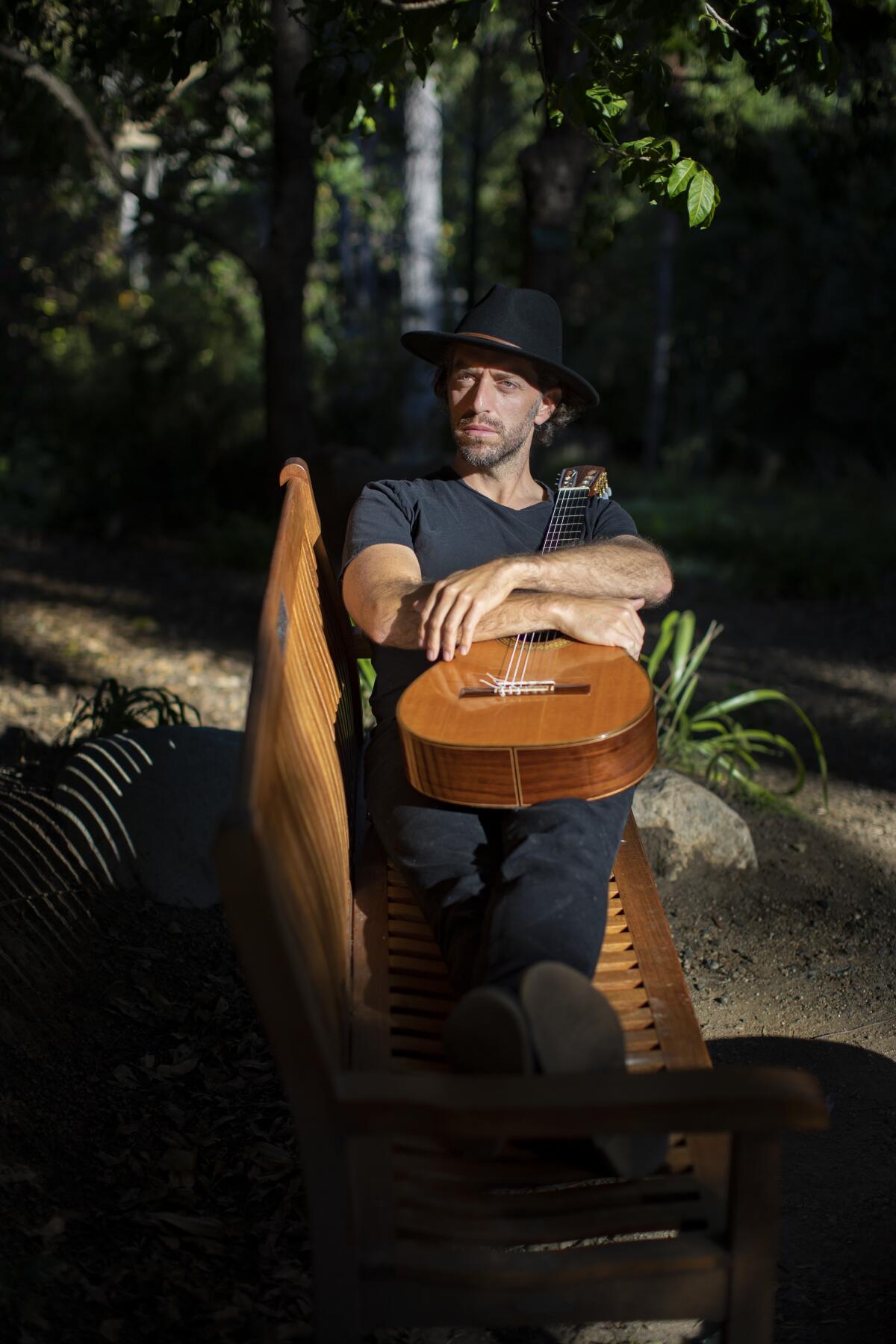
Faculty, Pepperdine University
Malibu, California
Giovanni Piacentini was born in Mexico City to an Italian-Mexican family, an origin that would come to define the singular voice threading through his work. He grew up immersed in the tonal colors of both cultures — the warmth of Latin folk traditions and the rigor of European classical form — before emigrating to the United States, where a third inheritance would shape him further.
He studied classical guitar and composition at the University of California, Los Angeles (UCLA), developing a technique-first practice grounded in the pedagogical lineage of the classical guitar tradition. His compositional voice emerged at the crossroads of that training and his multicultural roots, producing works that resist easy classification: too rooted in Mexican folklore for the European avant-garde, too formally rigorous for the folk world, too personal for either camp to fully claim.
That voice was heard at Carnegie Hall, where Piacentini's compositions received their New York premieres — a milestone that announced him to the international new-music community. The work drew comparisons that reached the press: The Los Angeles Times and Forbes both profiled his career, recognizing not just the compositions but the composer's unusual position as a cultural bridge-builder working at the highest levels of the concert world.
A Latin GRAMMY nomination followed — recognition that the recordings capturing his compositions had reached a popular and critical audience beyond the new-music circuit. Piacentini's recordings for Navona Records, one of the most respected labels in American contemporary classical music, gave his catalog a permanent home and introduced his work to listeners across North America and Europe.
Today, Piacentini holds a faculty position at Pepperdine University in Malibu, California, where he teaches classical guitar and composition while continuing to compose, perform, and accept commissions. His teaching practice reflects the same philosophy as his compositions: rigor and soul are not opposites. The guitar is capable of anything; the composer's job is to find out what.
His artistic vision remains fixed on the intersection. Mexican, Italian, and American musical traditions do not, in his hands, compete — they braid. The resulting work is, as the Winnipeg Free Press wrote, capable of encapsulating "tiny, winsome worlds as if passing through a gallery of paintings."